
Why your organisation’s most valuable customer knowledge lives outside every system you’ve invested in.
Every enterprise has invested in assembling a unified view of its customers. The Single Customer View — SCV — is one of the most established patterns in enterprise IT: it consolidates fragmented customer data from CRM, billing, ERP, support, and marketing systems into one authoritative profile. Account numbers, deal stages, billing addresses, transaction histories, support ticket counts, all of that get resolved into a single record.
The value proposition is straightforward: no more conflicting data, no more manual reconciliation, no more “which system has the right address?” The SCV was a genuine leap forward.
But there is something nobody talks about:
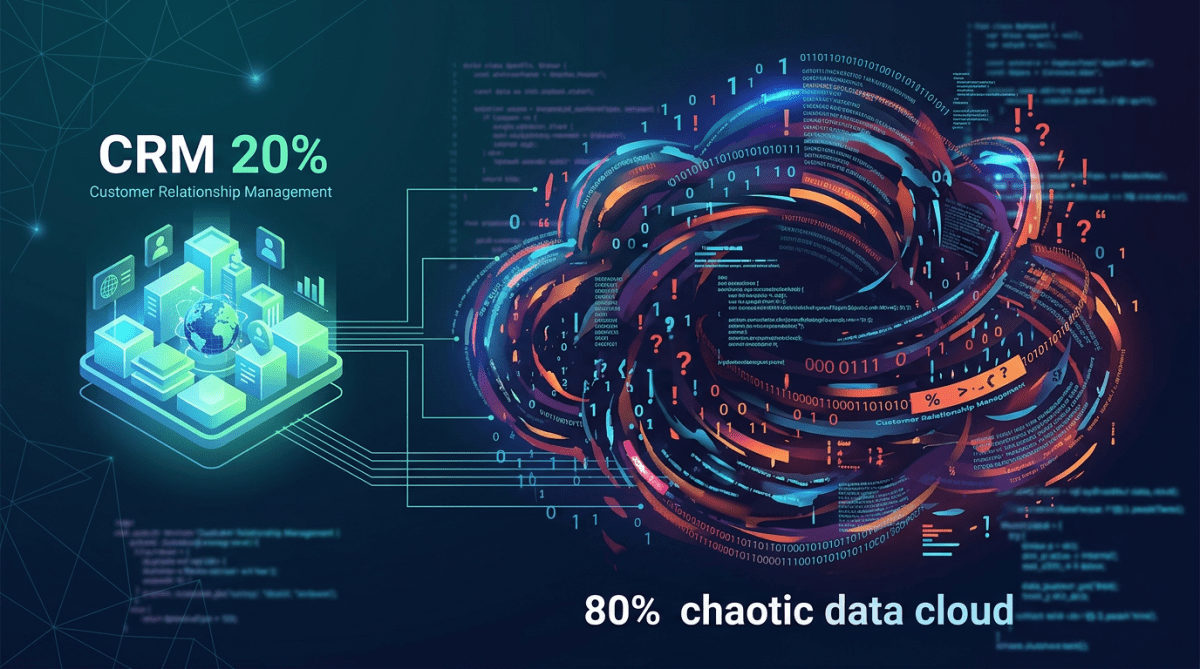
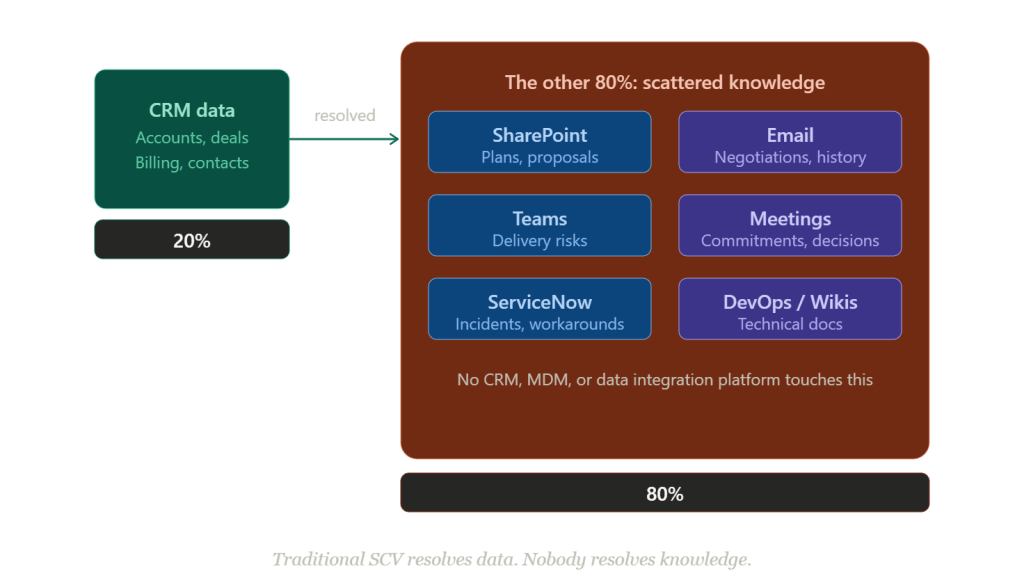
The Single Customer View only covers about 20% of what your organisation actually knows about that customer.
The 80% That Lives Everywhere Else
Ask anyone in the organisation “what do we really know about Acme Corp?” and the answer they want is not a CRM record. They want the full picture: the strategic account plan, the pricing commitments from the last negotiation, the technical risks the delivery team flagged, the competitive threats that came up in the executive review, the verbal commitments made in last quarter’s meeting, the incident pattern that support has been quietly managing.
None of this lives in CRM. It lives in the collaboration and documentation systems that people actually use every day:
| Source System | Knowledge the SCV Misses |
| SharePoint | Strategic account plans, proposals, contract reviews, competitive analysis |
| Email (Exchange) | Pricing negotiations, relationship history, escalation threads, commitment language |
| Teams | Delivery discussions, implementation risk assessments, cross-team coordination |
| Meetings | Verbal commitments, decision rationale, stakeholder concerns, action items |
| ServiceNow | Incident patterns, root cause analyses, workaround documentation |
| Azure DevOps | Custom integrations, technical debt, deployment runbooks, API documentation |
| Confluence / Wikis | Lessons learned, onboarding guides, technical specifications |
This table is not hypothetical. It reflects the reality of every enterprise organisation I have worked with. The structured data in CRM is essential but it is the tip of the iceberg. The real knowledge — the kind that wins renewals, prevents escalations, and informs strategy — is overwhelmingly unstructured and scattered.
The Pre-Meeting Problem
Here is a scenario that plays out in every enterprise, every week:
A sales director has a strategic account review tomorrow morning. She needs to prepare. She opens CRM and gets the structured data: deal value, renewal date, contact list, recent support tickets. That takes five minutes. Good.
Then she needs the other 80%. She searches SharePoint for the latest account plan — finds three versions, two from different teams, one clearly outdated but no indication of which is current. She checks her email for the pricing thread from last month’s negotiation. She messages a colleague on Teams to ask about the implementation risks that were flagged. She discovers that the person who took notes in the last executive review left the company three months ago and nobody can find the notes.
Two hours later, she has assembled a partial, unreliable picture. She walks into the meeting knowing she does not have the full story. She is not confident she has the latest pricing, the current risk status, or a complete understanding of the relationship history.
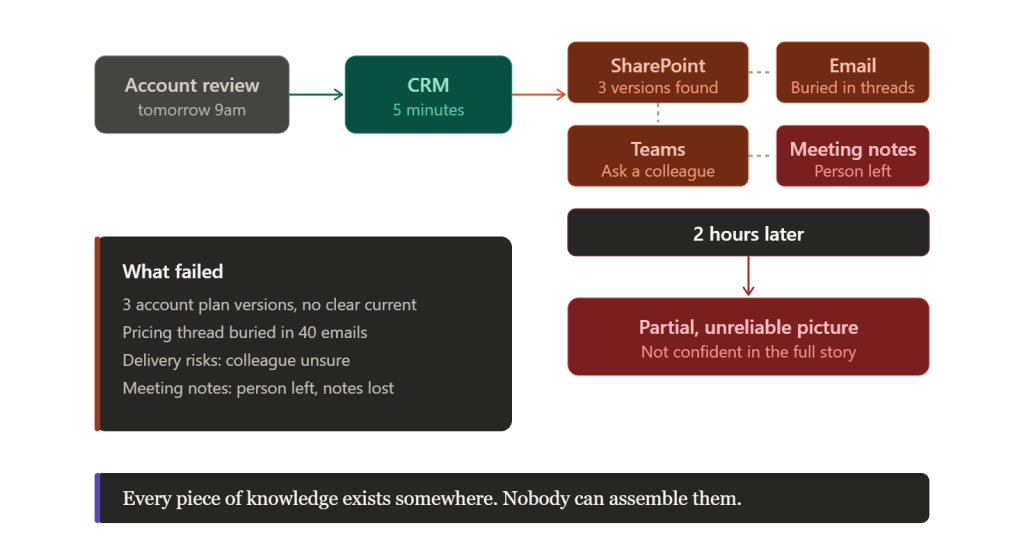
This is not a technology problem. It is a knowledge assembly problem. Every individual piece of knowledge exists somewhere. Nobody can assemble them into a single, reliable, governed view.
It’s Not Just Customers
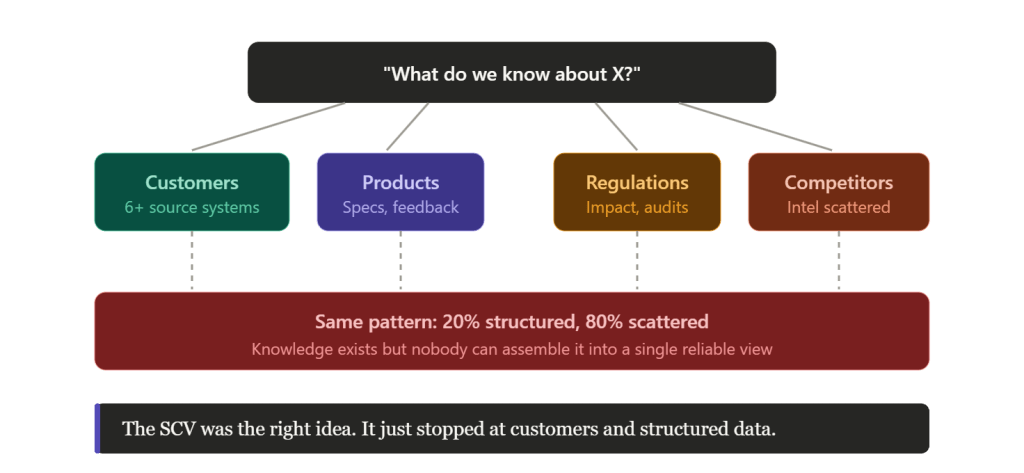
The most important insight is that this problem is not specific to customers. Every significant entity the organisation deals with suffers from the same fragmentation:
- Products: Technical specifications in Azure DevOps, marketing collateral in SharePoint, customer feedback in ServiceNow, competitive positioning in email threads, roadmap discussions in Teams. Nobody has the complete picture.
- Regulations: The regulation text in a compliance repository, the impact assessment in SharePoint, the implementation decisions in email, the audit findings in a separate system, the training materials in the LMS. No single view.
- Projects: Requirements in one system, designs in another, decisions in email, risks in a spreadsheet, lessons learned nowhere. The organisational memory of the project is scattered across a dozen systems.
- Competitors: Win/loss reports in CRM, competitive analysis in SharePoint, field intelligence in email, pricing observations in Teams. The organisation’s collective competitive intelligence is fragmented beyond assembly.
The pattern is always the same: structured data lives in one system, but the real knowledge — the context, the decisions, the relationships, the risks — is scattered across every collaboration tool the organisation uses.
Why Current Approaches Fail
Organisations have tried to solve this in various ways. None of them work:
- Manually curated wiki pages are instantly stale. They reflect a single author’s perspective at a single point in time. No quality scoring, no governance, no cross-source assembly. The wiki becomes a graveyard of good intentions.
- Pre-meeting research across multiple systems is time-consuming, always incomplete, and entirely dependent on the individual knowing which systems to check. The person who left took their knowledge of where to look with them.
- Tribal knowledge and “ask around” is unscalable, unreliable, and permanently lost when people leave. It is the single biggest knowledge risk most organisations carry and the one they are least equipped to quantify.
- Periodic account reviews and QBRs are point-in-time snapshots, manually prepared, and often outdated by the time they are presented. They create a false sense of completeness.
The Real Cost
Entity knowledge fragmentation is not just an inconvenience. It has measurable business impact:
- Pre-meeting research takes hours, not minutes. Multiply that by every strategic account, every week, across every account team. The cost is staggering.
- Account reviews are always stale. By the time a QBR deck is assembled, the information is already days or weeks old. Decisions are made on incomplete data.
- Tribal knowledge walks out the door. When Sarah left, she took her understanding of the Acme relationship with her. Nobody documented it. Nobody could.
- AI agents act without complete context. When you deploy AI on top of fragmented entity knowledge, the AI confidently acts on a partial picture. This is worse than no AI at all.
The Question Nobody Can Answer
Here is a test: pick your most important customer, and try to answer this question:
Show me everything we know about them.
Not the CRM record. Everything. Every proposal, every negotiation thread, every delivery risk, every commitment, every escalation, every lesson learned, every competitive threat — assembled, current, and reliable.
If you cannot answer that question in under five minutes, you have an entity knowledge fragmentation problem. And it is not limited to customers.
The Single Customer View was the right idea. It just stopped at the structured data layer. The 80% that matters most — the unstructured knowledge scattered across every collaboration system in the enterprise — remains invisible.
Next week: who owns this document? The accountability gap hiding in your SharePoint.

 Donald Mucci